Make room for the particular person
When a child says they miss a friend, replying that they will soon make new ones may skip what they are telling you. Ask what they miss about that person: the game they played, sitting together at lunch, or knowing that someone understood a joke. You can listen to that detail without promising that the new school will provide an equivalent immediately.
A child may want to talk, look at a photograph, send a message or do something unrelated for a while. Offer choices rather than deciding that every mention of the friend requires an organised call. Missing someone can appear at an ordinary moment, not only when the family is already discussing the move.
Help the adults arrange the contact
For younger children, agree the channel and timing with the other parent. A short voice message or photograph of a drawing can be easier than finding a live calling time across several time zones. Check what the other household is comfortable receiving and how often.
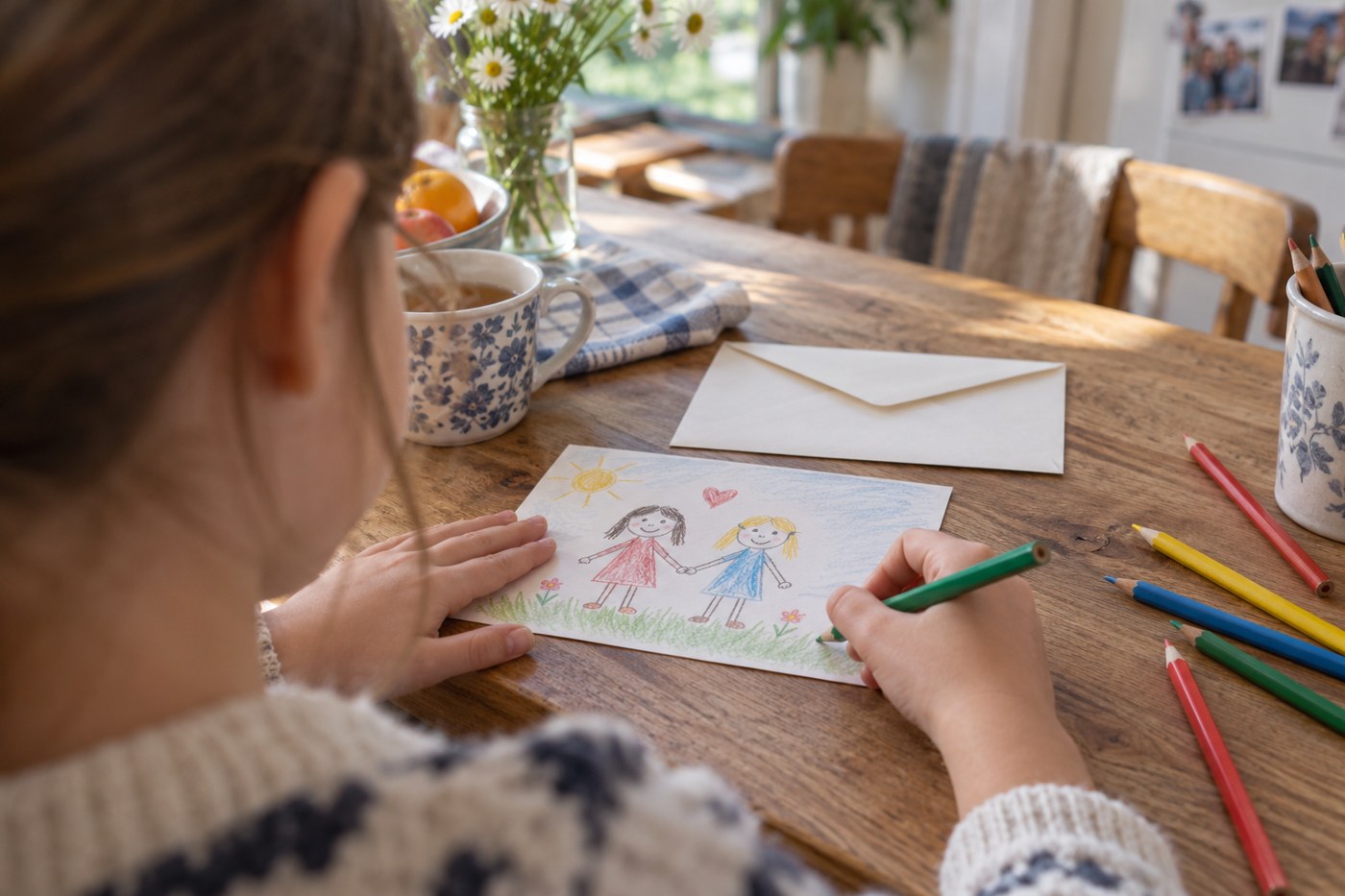
Give the child a concrete way to contribute. They might describe a new playground, ask whether a shared game has changed, or draw something for their friend to finish. Avoid making each message a display of how wonderful the new country is. Ordinary news leaves more room for an honest exchange.
Postal contact can be enjoyable if both families are comfortable sharing addresses. Explain that delivery may take time and that a late reply is not a reliable measure of the friend's feelings. Adults can quietly check whether a message arrived instead of leaving a child to guess.
Keep old and new friendships out of competition
Do not require the child to reduce contact with an old friend simply to demonstrate that they are settling in. Equally, help protect sleep, school and opportunities to participate locally. Agree boundaries around devices and calls in the context of the whole week, not as a punishment for caring about someone far away.
Some friendships will remain close; others will become occasional. A missed call or a changed interest does not require a dramatic verdict. If the relationship becomes one-sided, you can acknowledge disappointment while helping the child decide whether to send another message or leave space.
Save a few reminders if the child wants them: a photograph, a card, the name of a game. They can value the friendship even when its everyday shape changes. Making room for that history also leaves room for new people, without asking the child to erase the ones who mattered before.