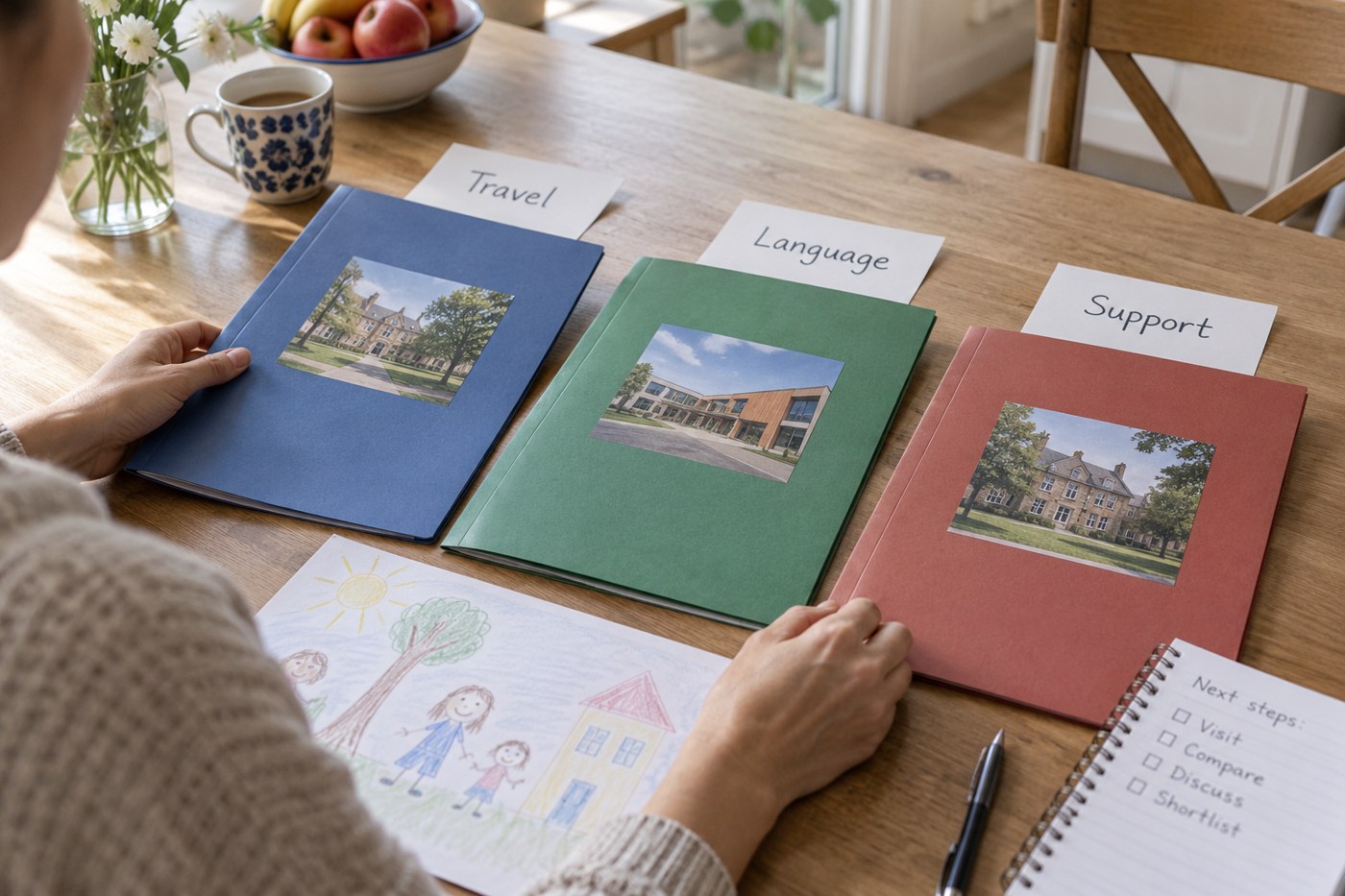
Bring a picture of your child’s day
A school visit can leave you remembering the bright art room and forgetting to ask how a new child finds someone to sit with at lunch. Before going, think through an ordinary day from your child’s point of view. The questions that follow will usually tell you more than a request for the school’s strongest selling points.
Choose a few priorities rather than carrying a questionnaire so long that there is no room to listen. Your child may be joining halfway through a year, learning in a new language or arriving from a school with a very different routine. Describe the relevant starting point in concrete terms. “She reads confidently in Spanish and is just beginning English” gives the school something clearer to respond to than “Will she cope?”
Ask which parts of the visit will show a normal working day and which are arranged for prospective families. An open event can introduce staff and facilities, while a separate conversation may be needed about an individual learning or access requirement. Availability and admissions processes vary, so find out how the school handles these conversations before assuming the tour covers them.
Follow the transitions as well as the lessons
Ask what happens when a child arrives on the first morning. Who meets them? Where do they put their belongings? How do they learn the timetable, find the toilets and ask for help? These small transitions can reveal whether the school has a clear way of welcoming someone who does not yet know its habits.
During the visit, notice the spaces between organised activities. Ask how lunch, breaks and movement between rooms work for new pupils. You are looking for an account of what staff actually do, not a promise that every child settles immediately. A named point of contact and an explanation of how concerns are followed up are easier to use later than a broad assurance that the school is welcoming.
If language support matters, ask who provides it, when it happens and how it connects with classroom learning. Find out how teachers distinguish unfamiliar vocabulary from an unfamiliar subject. Request information relevant to the programme your child would enter; do not assume that an approach described for younger pupils also applies to the secondary years.
Make the family arrangements part of the conversation
The school day also has to fit the family’s actual circumstances. Confirm start and finish times, the usual communication channels and any arrangements you would rely on, such as transport or care beyond the teaching day. Ask which details are confirmed and which depend on demand or availability. Record where the current written information can be found.
Consider how you would communicate when something goes wrong. If you do not speak the school’s main language confidently, ask what support is available for meetings and messages. A child should not have to carry the responsibility for explaining a sensitive conversation between adults. Agreeing on a workable channel is more useful than hoping important information will always arrive in an easily understood form.
Keep administrative questions separate from impressions of the classrooms. Fees, eligibility, required records and application deadlines should be checked directly against the school or responsible authority’s current information. A pleasant visit does not confirm a place, and another parent’s account may refer to a different entry year or set of circumstances.
Compare notes before deciding what the visit meant
Afterwards, give your child room to mention what stood out without immediately asking whether the school was good or bad. A younger child may remember the playground; an older one may notice how pupils speak to teachers. Those observations do not have to settle the decision, but they can suggest a question you missed.
Write down three separate things: what you observed, what someone told you and what remains unanswered. This keeps a confident presentation from becoming evidence of a service you have not yet confirmed. If you visit another school, use the same few priorities so that the comparison is about the child’s day rather than which tour was more polished.
Send a short follow-up for the unresolved points that could change your decision. You do not need certainty about every future school day. You do need enough specific information to understand the next step and the questions that still belong to it.